Read This!

Krishnas

Christine is watching a cooking show about fine Korean cuisine. It looks delicious. This particular outlay is apparently the food of monks.

I said it looked delicious and she told me it was and, btw, when she was a child in Queens, she found out that if you bowed enough, the monks would give you delicious food.

I responded, “oh, yeah. The same thing happened with me with the Hare Krishnas.”

When I said that, she looked at me like I was from outer space.

A Day in the Life

Today I made chicken soup, went out for flu supplies, entertained a five year old with microscope slides of cotton and beeswax, cracked open a gourd with a table saw, supervised the painting of said gourd by said five year old, shepherded the cleaning of the brushes (and the walls, railings, and rug), guided said five year old through cleaning her own damn self with a wash rag in the bath, built a fire, brought chicken soup to sicky pants, went down to make a hot toddy…

and Stephen Hawking died.

Life is a strange, fragile, and beautiful gift.

If We Only Understood Risk

It’s a damned shame that, as a species, we tend to have a complete shit comprehension of risk. If we did, it would make many collective decisions better.

Consider air travel. It’s staggeringly safer than driving. Whether measured in deaths per mile or deaths per hour, air travel is orders of magnitude safer than driving. But, almost no one fears driving while millions fear flying.

The same is true of violent crime. The violent crime rate is insanely low–measured in a few people per hundred thousand. Historically, risk from violent crime is essentially non-existent. Pre-historic death rates from violence are somewhere around 15%. That’s fifteen out of 100 people. We now see death rates from violence at something more like 0.0005 in 100 per year (about 5/100K/year–I may have gotten the decimal wrong and you have to do more math to figure out the lifetime risk–but, you get the point). And yet, millions are scared of violent crime. Risk of violent crime for almost everyone is vanishingly close to zero. We die of disease and accident, not crime. And yet, fear of crime drives politics wildly out of proportion to the risk.

It’s even more ridiculous when it comes to terrorism. How many people do you know that have died of terrorism vs those who have died of car accidents or at the end of a gun? For me, the first number is zero. I’m pretty sure I don’t even know someone who knows someone who died from terrorism. But I know at least 10 people who died in a car or by gun. Terrorism is NOT A RISK.

Well, that’s not exactly true. There is a very real risk of nuclear terrorism which could very well kill millions to billions. But that, in the parlance of risk, is a black swan event. Like a meteor striking the earth or Yellowstone erupting. The risk of a black swan event actually happening is fairly to very low–but the effect is so enormous that you have to pay attention to it.

That being said, keeping Muslims out of the country has nearly zero likelihood of decreasing such a black swan event.

And yet, the fear that drives national policy more than any other is terrorism–an essentially non-existent risk.

So, now let’s look at the banking industry, which is what sparked this particular line of inquiry.

The banking industry, like the insurance industry, is based almost solely on risk. Banks make investments or loans in order to make money. The likelihood of an investment or loan returning a profit is entirely about the level of the risk a bank takes in making the investment (from here, I’ll call loans investments, because they are).

If the investment is almost sure to return a profit, it has very little risk. Investing in US Treasury bonds has very little risk because the US government has a near-perfect history of repaying its bonds. Because the risk is low, the return on investment is low. Because it’s much safer to invest in treasury bonds than, say, what might be next Facebook or might be a a pile of crap, the treasury can borrow money and pay little interest (interest is essentially the amount a borrower pays back to the lender in addition to principal for the courtesy of having kept the money for some period of time).

So, knowing this, banks, like other investors, seek investments that have higher yields than the safest bets. Fair enough. That’s their job.

Here’s where the problem of humans not understanding risk becomes utterly poisonous.

Most individuals and companies take risks according to their appetite for failure. You might give your cousin Joe $1000 for his new business idea, hoping that he’ll turn it into something great and you’ll get $10,000 back. But if Joe *doesnt* pay you back, you’re out $1000 and that sucks for you. The same is true of most companies. If they fuck up, sucks for them.

This is NOT true of banks. And that’s for two reasons. The first is that up to $100,000 of their depositors’ money (per depositor) is insured by the FDIC. That means that depositors (you and me with bank accounts below $100,000) don’t need to pay attention to the soundness of their bank. Depositors get their money back if the bank fails. That’s good. Most people don’t know how to judge risk and can’t tell the difference between a bank that’s in sound health and a bank that’s about to fail and take all the money with it.

Or, it would be good if the banks weren’t allowed to gamble with the money that their depositors invest. The Glass-Steagal act–the one from the 1930’s that Bill Clinton repealed, was enacted to stop banks from making risky bets with depositor money. When it was repealed, it allowed retail banks (the banks you have your checking account in) to also act as investment banks (banks that have an incentive to take larger risks with your money with the hope of larger returns).

If the Glass-Steagal act had been repealed in a way that removed FDIC protection of depositors from those banks that wanted to take big risks, that would have been sort of fair. Banks could forego FDIC insurance to invest with more risk. People like you and me with a higher appetite for risk might be tempted to invest in such a bank, even though our deposits would be at risk should the bank fail, because the bank would offer higher interests rates to us because the risk was higher.

But, that’s not what happened. Banks with FDIC insurance are allowed to make risky bets on federally insured money. They still had the existential risk of making so many bad bets that they failed, but they make those bets with money you and I put in–and they don’t have to pay a higher cost for that money because it’s insured by the federal government–that is, you and I don’t demand a fat interest rate on our deposits because they aren’t at risk (because we’re guaranteed to get that money back no matter how badly the bank fucks up). No other business that isn’t subsidized by the government has that kind of freedom from the cost of risk (ok, well, there are a fuck-ton of government-subsidized businesses, including much of agriculture, sports, I could keep going, but that’s another topic).

Ok, so that’s really bad. It means that the banking industry is allowed to discount their risk of failure because the government insures its depositors.

But it’s so many times worse than that, as the 2008 financial crisis exposed.

The banks, not content with an already ridiculously unfair advantage, ratcheted up their appetite for risk to delusional heights with a nationwide shell game.
American home loans have traditionally been very safe investments because Americans tend to pay their mortgages before they pay any other bill. That has a lot to do with how Americans feel about their homes, but also who banks have traditionally decided to lend to. Traditionally, banks don’t lend to people who aren’t likely to pay them back. That’s why home loans are traditionally rated very highly by the ratings agencies (Moody’s, etc. ). The rating agencies are supposed to give a rating on an investment based on how risky it is. The lower the risk, the higher the rating.

HOWEVER, in the years leading up to 2008, all of that went to shit. The banks (along with pure investment firms like Goldman Sachs, Lehman Brothers, etc) developed a towering appetite for new home loans because there was a housing bubble. That caused an army of mortgage brokers to scour the earth for anyone who would sign loan papers. The banks wrapped up those loans into “tranches” and sold shares in them (“securitized” in the parlance). The rating agencies stamped them with the standard high rating of traditional home loans even though they were actually piled of shit, again utterly discounting the actual risk.
When risk is severely discounted, it causes people to make bad decisions. The bad decision was to keep extending credit (which wasn’t priced properly because the risk was discounted), and the entire country gorged on real estate, sending prices into the stratosphere based on nothing but cheap, risk-discounted credit.
In addition to discounting the risk, the same banks invested in credit default swaps which is a complicated way of ensuring against risk. I don’t fully understand how these worked, but I know that they are responsible for taking down AIG, the largest insurance company at the time, which was essentially insuring huge quantities of bad loans far too cheaply because the risk wasn’t priced properly.

When the shell game finally came to an end, there was plenty of carnage. Lehman Brothers was allowed to fail over a weekend in September of 2008 (the same weekend I saw Bernie Sanders on the Senate floor for the first time, ranting in his inimitable way). Other institutions were failed or reached the brink of failure.

Instead of letting the whole system crash, the Bush Administration, under the guidance of Hank Paulson, former CEO of Goldman, pushed through the trillion-dollar TARP bailout (ok, $900 billion, but who’s counting at this point) which SAVED THE BANKS (and AIG and General Motors, etc.) FROM FAILING.

The government eventually got most of its money back, but the giant travesty is that the very institutions responsible for massively discounting risk were left standing, essentially unscathed.

Congress passed the Dodd-Frank Act, which is a pale shadow of the Glass-Steagal Act, but at least it was something.

But, the biggest banks got even bigger because they were forced to buy weaker banks (BofA bought Countrywide, JPMC bought Bear-Stearns, etc.). Jamie Dimon and company got to keep their companies.

And here’s the lesson they learned: risk is free because when the shit hits the fan, the Federal government will bail them out.

Now, the banks are gunning hard to repeal the Dodd-Frank act and Trump and the fucking GOP are gung-ho to do it for them.

If 1) your cousin Joe asked you for $1000 to invest in his steal-all-the-underpants business and 2) the upside was you get $10,000 if he succeeds and 3) the downside was you get your $1000 back if he fails, you’d give him the one-large every time, even if you suspected he might be buying and smoking crack with the money. You’d do that because the risk was free.

So, back to humans and how we don’t understand risk.

The world is dangerous. Risks abound. But, accurately assessing risk is fundamental to making good decisions.

Violent crime is not a risk worth noticing, compared to all the other things that can hurt and kill you. It shouldn’t drive national policy.

Terrorism is even less worth noticing than violent crime. Certainly not worth spending trillions of dollars on war and giving up the freedoms we relinquished with the Patriot Act and the creation of a national security state. Terrorism is as risky as tetanus. Maybe less. And yet it drives national and foreign policy and has turned us into a nation of fucking cowards.

The real risks–the risks that should drive national policy–are the risks of going bankrupt from a health problem and the risk of the banks crashing the economy again because they are immune from risk.

Those risks are being deeply discounted by the GOP RIGHT FUCKING NOW. Those are risks you will feel and pay for.

In the meantime, enjoy the beautiful border wall we’re planning to build.
Freedom

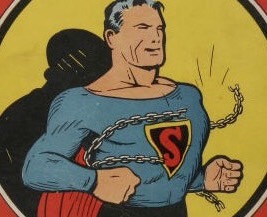
There is a tipping point beyond which one’s wealth increases on its own. Given enough time and/or enough wealth, the pot grows—all by itself—beyond what anyone could ever need.

This tipping point is the dividing line between the wealthy and everyone else.

It’s very hard to reach the tipping point by yourself. It takes either extraordinary effort, good timing, and luck to make enough money or an extraordinary amount of self restraint to keep one’s spending below one’s income for long enough to get there.

But, if wealth is passed from one generation to the next for long enough, scions of a wealthy family find themselves past the tipping point without ever lifting a finger. Once wealth is captured in this way, it self-perpetuates.

All things being equal, I would like to see inherited wealth abolished. Whatever wealth you have accumulated at the time of your death should be deposited in a fund that serves as an endowment for a universal basic income. 

This would go a long way towards leveling the playing field. This would ensure that the wealthy were those who created that wealth. 

There has been a big fuss today about the eight or so richest people in the world owning as much wealth as the bottom 2.5 billion.

Many of those people created that wealth on their own (minus their social advantages): Warren Buffet, Jeff Bezos, Bill Gates, and Mark Zuckerberg are among them.

Hats off to them. Each of those people has created a great deal of value, essentially from scratch (again, they each had social and historical advantages, but those advantages reduce to nothing compared to the scale of their achievements). They deserve the money they made and the power and glory that goes with it. 

But, their children do not.

Imagine a world in which, at the end of their lives–after they have enjoyed their wealth and, hopefully, put it to good use–the fortunes of everyone went into the aforementioned fund.

That fund would, in a generation, be an endowment capable of providing nearly everyone on earth a stipend large enough to cover basic needs. A few generations later, the fund could provide a stipend large enough to provide every person on earth with enough income to live a decent, American middle-class style life.

A few generations more and every person on earth would have more income than they would know what to do with.

But, wait! I hear the chorus cry: that would create a world of idle fools. There would be no incentive to work!

Is that really true? In a world where everyone has what they need, would everyone really do nothing? Would the system collapse under its own weight?

I think not.

The human condition is to strive. The same incentives to create great things that drove the aforementioned billionaires would still apply. They might not have at their disposal a sea of wage slaves, but they would still be challenged to make great things–and they would figure out how to motivate the people they need to their cause (as they already do). They would also figure out how to fill in the gaps with machines–as, in fact, they already do.

There are plenty of people in the world with great dreams and the intelligence and fortitude to realize them. The great projects would commence apace. 

What of the rest of humanity? The rest of humanity would indulge itself in whatever fascinated them. Many–perhaps most–would make nothing of their lives beyond living them. What of it? Before civilization, that was the state of all people. We’d just be doing it without being chained to a Malthusian cycle.

Think of the millions of potential world-changers whose lives have been constrained or destroyed by circumstance. The world I’m asking you to imagine frees them from their chains. Since every person would have an equal shot at greatness, every potentially great person would have the means, at least, to try. Nearly none of them will achieve it, luck being what it is, but how many more Newtons and Einsteins would we see?

I predict legions, free at last.

Trumpgrets

The Trumpgrets tumblr is fascinating. Of course, most of the appeal is pure schadenfreude, but the reasons people give for their regrets is worth knowing.
Much of it is complaints that Trump isn’t doing what he said he’d do. Duh. What politician ever does that? Most of the time they don’t deliver because their promises were impossible. 

Many of the complaints are that he’s doing the opposite of what they expected. This is different than a politician not doing what they promised. This is about a politician not even trying to deliver on promises–in fact, actively acting against those promises. Trump has indeed flipped 180 on many of his promises and the general spirit of his campaign (complaints include not prosecuting Hillary, filling the cabinet with swamp people, meeting with Romney). Again, though, what did they expect? Trump has a long and public history of renegotiating deals after the fact. What would make anyone think he wouldn’t keep doing that?

Some of the trumpgrets are that he isn’t actually the far-right ideologue he appeared to be. Again, what about a New York billionaire with a short as fuck track record as an ideologue would convince anyone that he had the bona fides to deliver?

I know for a fact that there are thousands, probably millions of Trumpkins who are still stoked as fuck. But, the rest are just fucking rubes played by a giant con. 

You know what they say about confidence schemes: you can’t con an honest man.

If I Were Trump

Here’s what I would do in my first two years if I were Trump.

First, I would create alliances with congress and make agreements with them that they can do whatever they want if they let me do whatever I want.

Then, I would start a concerted effort to scoop out the federal bureaucracy to remove those who might oppose my actions. I’d start by placing people opposed to the mission of the various agencies as the leader of those agencies. (He’s already done that.)

After the appointments, I’d probably hand the execution of those purges to Steve Bannon who will do it with glee.

I’d also work with the Ayn Rand Republicans in congress to pass a budget that slashes funding for most of the federal agencies to further shrink the bureaucracy through layoffs and attrition. That same budget would transfer much of those “cost savings” to the military budget, making the military my client.

Next, I’d use the FBI and the CIA to build compromising dossiers against any possible enemy in congress and the military.

I’d use whatever dirt I’d found to either oust or destroy the credibility of my enemies in congress and the military.

Once my inroads in the military were strong enough, I’d start replacing generals. Each new general would be picked specifically for their fealty to me.

In the mean time, I’d classify pretty much every action I take so the press can’t report on it. They’ll spend years and treasure on endless FOIA requests, unable to report on what I’m doing until it’s a fait accomplis. I’d also revoke the press credentials of the most potent news outlets, starting with the NYT, WaPo, etc. to further obfuscate my activities.

I’d get Bannon to set up a quasi-state news organization. This would be how I communicate my agenda to my followers. There would be no press conferences, but plenty of propaganda about what the White House is doing via this organization’s channels and my personal Twitter feed. 

In addition to my propaganda channels, I’d also use my twitter account to mobilize my private militia of “second-amendment people” to intimidate private citizens critical of me. Ultimately, I’d whip them into a frenzy strong enough to effect executions. These would be my brown shirts. They’ve been waiting their whole lives to answer this call.

You can see where this is going. It’s a pretty standard Machiavelli-style soft coup.

I don’t know if he’ll actually do these things or, if he tries, if he’ll succeed, but he’s already executing the playbook

Battle of Demons

There is apparently some ideological storm brewing between Steve Bannon and Paul Ryan.

There is much about Bannon’s views on economics and the financial industry as described in this article from New York Magazine that I agree with.

Unfortunately, his good ideas are so twisted up with and by terrible religious ideas and white supremacy as to make him more a threat to the economy and civil society than even Paul Ryan (whose worship of Ayn Rand is both ludicrous and dangerous).

I agree that “corporatism” is bad for everyone. There’s nothing inherently wrong with corporations, but when they have too much power and are not subject to ethical constraints or anti-trust action, they destroy the economy (by placing too much power in too few hands) and tear the social fabric (by reducing their workers and their customers to faceless commodities). Corporatism seeks market share, short-term profit and stock market valuation above all else instead of creating value, serving customer needs, and investing in a work force that can afford to participate in the economy.

This bad behavior has been ravaging America for decades by shipping capabilities overseas in the interest of short-term cost cutting and concentrating market share to the point that no one is served, not even customers, except shareholders.

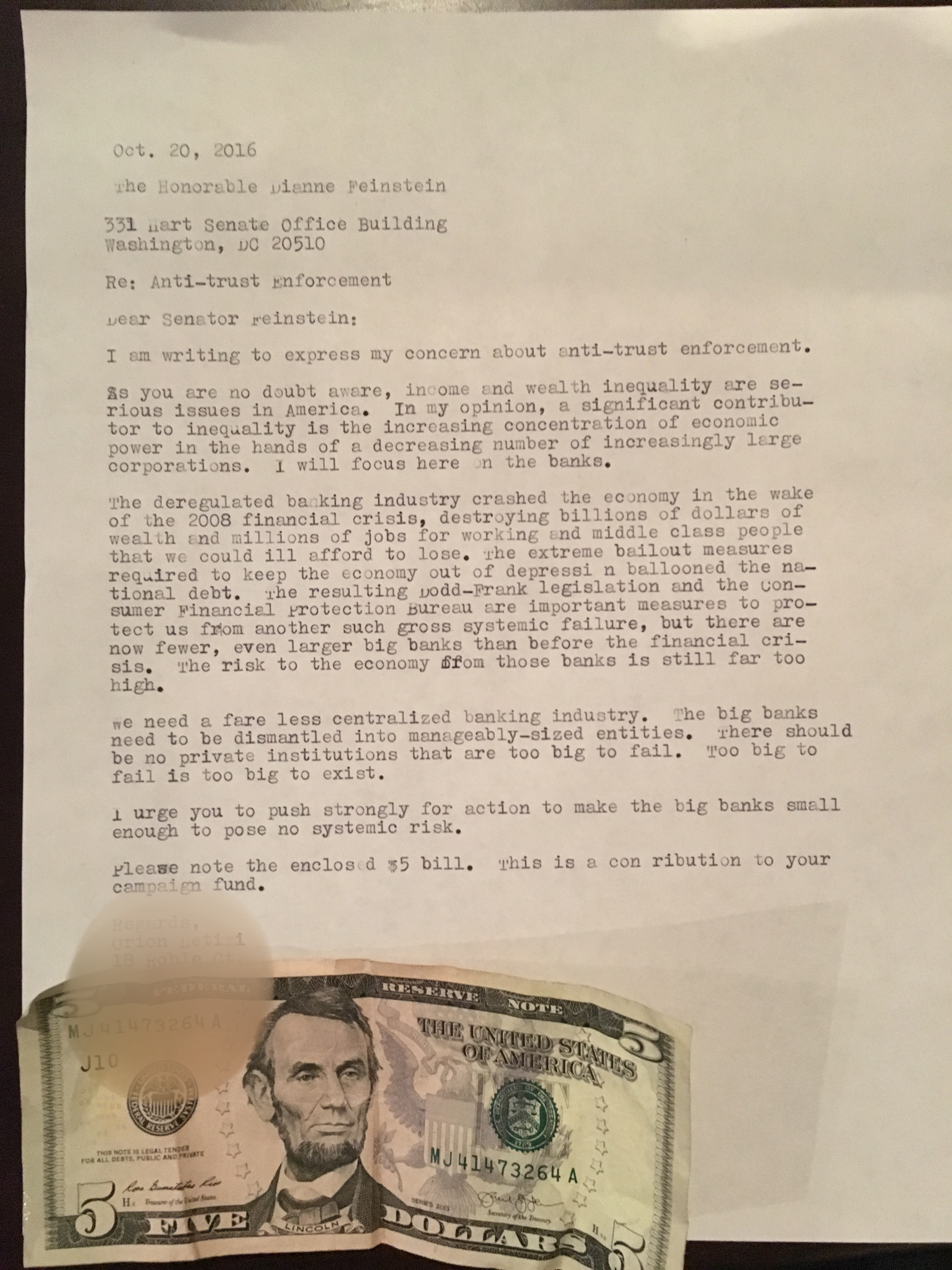
In the case of the financial industry, this unbridled power has already nearly destroyed the world economy. And, because the bad actors are so wealthy–and, as a result, so powerful–they have been almost wholly uncorrected. The banks are still allowed to be both traditional retail banks and risky investment banks. The staggeringly large financial bailouts the industry received did not also come with corrective rebuke. There are fewer, even larger banks now than before 2009 and the same people are still in charge, garnering even more wealth and power. Instead of being restricted in their ability to crash the world economy, the risk is even higher that they will do it again.

If Bannon weren’t corrupted by his bizarre notion that “Judeo-Christian values” undergirded the historical success of capitalism–coupled with a white nationalist ideology that makes him balk at Silicon Valley’s success because it has too many south-Asian people in it; if he weren’t poisoned by delusion and hatred, he could possibly be a force for good in the world.

Do Not Go Gently

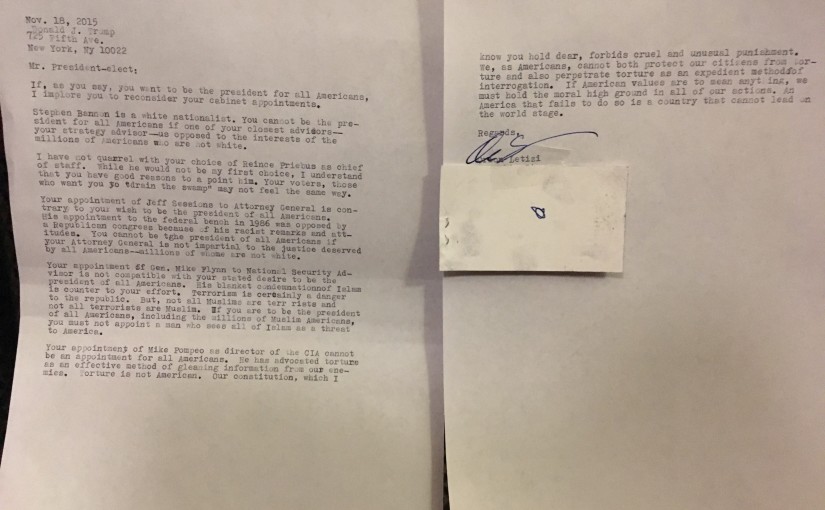
Letters to… the President-Elect:

This is an encouragement to reconsider most of his cabinet appointments.

While writing this, I found myself using elevated language, devoid of the deep anger I feel in my heart. I used an appeal to American values above all else.

Why did I do that? I don’t really know myself. Perhaps because I believe deeply in America–though I am heartbroken–and I wish beyond wishing and hope beyond hoping that someone as venal as our next president may be newly enthralled by those values as much as I am. 

I hold out not much hope that this is and will be the case. But, if I am to be an American at all, I must try.

Please, all of you who read this, please take action. Do not sit idly by. Do not go gentle into this good night.

Twitter, Facebook, and Free Speech

Twitter has suspended alt-right accounts. This is both good and deeply troubling.

It’s good because the alt-right needs to be crushed. It’s bad because it’s the wrong long-term implementation. 

It’s probably the right thing for Twitter to do in the short term. There’s no first amendment constitutional issue here, because Twitter is not part of the government. They are free to set whatever terms they choose regarding speech on their platform. And, this action is akin to putting out a fire that threatens to burn down the entire house.

Facebook doesn’t have exactly the same problem, since they have built-in mechanisms for protecting users from each other. But, Twitter has been and is being used as a way to publicly harass individuals. Hate speech on Twitter is more directly harmful to other users than on Facebook.

But, there’s a big long-term problem that must be addressed. The problem is rooted in the vast shift of public discourse to private platforms.

The government is not allowed to constrain speech except under special circumstances. As public discourse has moved from the public square, so to speak, to privately run commercial media platforms, the issue of free speech on those platforms has become an issue not addressed by the constitution.

The share of public speech not controlled by these platforms is trending to become vanishingly small. That means that the constitutional right of free speech is simultaneously becoming vanishingly small.

The wisdom of entrusting private, commercial actors with the bulk of our communication payload has become virtually irrelevant. They work so well most of the time, it’s not likely to change any time soon.

But, that does leave two people, Mark Zuckerburg and Jack Dorsey, increasingly responsible for ensuring the right of free speech in America.

This will likely change. These kinds of monopolies don’t last very long. But, in the meantime, these two men are ultimately responsible for the bulk of speech made by hundreds of millions of people.

So, what will they choose to do with our speech?

Their current tactics are censorship. But, that can’t be part of a long-term strategy that allows free speech.

In the case of Facebook, they could relatively easily contextualize what people post on the platform. They could, for example, provide a built-in truth/hate meter for posts that are either demonstrably false or are from sources known to peddle in falsehoods or hateful distortions. Sort of like rotten tomatoes for information sources.

But, Twitter has a harder problem. They could implement similar contextualizing devices for tweets referencing outside content. But, they can’t continue to ban users altogether because those speakers have proven to be bad actors. 

Perhaps they could fragment their user base, creating quarantine groups of users known to violate rules against hate speech. Then, people could opt-out from receiving tweets from hate speakers. But, this approach would both violate the underlying principle of Twitter and, worse, leave Twitter in the position of arbitrating who is a hate speaker (which is what they are doing now). So that’s not really a solution.

I honestly don’t know–as, I suspect, Jack Dorsey doesn’t know–how to resolve this issue. My guess is that Dorsey had no idea what he was getting himself into. Likewise, Zuckerburg.

That being said, if we are to continue to be a free society and if we are to continue to use these private platforms to shape our understanding of the world, those two men have a lot of thinking to do.

I hope they are up to the task.